
University of Malta
Dr. Jaafar Alloul
September 23, 2025
Between August 14 – August 24, 2025, I spent time at the University of Malta (UoM), under the auspices of the ‘European Cooperation in Science & Technology’ (ECOST). Through a ‘Short-Term Scientific Mission’ (STSM) of the research stream on the ‘History of Identity Documentation in European Nations: Citizenship, Nationality and Migration’ (HIDDEN), and in collaboration with Prof. Dr. David E. Zammit and Dr. Ibtisam Sadegh (UoM) in the ECOST Working Group on “Losing Citizenship”, I set out to explore joint research ideas through the project Gauging New Global Trends in Citizenship Through the Lens of Malta’s Classed Migration and Citizenship Regime.
The objective of the STSM was to understand the latent global changes in liberal citizenship regimes, where citizenship is becoming more conditional (revocable), incrementally more exclusive in terms of stepwise accessibility for (long-term) residents, while increasingly advertised as a “commodity for sale” (Surak 2023) in seeming contravention with the basic tenets of Liberal philosophy on matters of state-citizens relations and sovereign political representation. Increasingly, such global (punitive) trends appear to get complemented today with circulatory migration regimes that temporarily source foreign blue-collar workers for specific periods of time, thus exempting the latter bulk of residents by design from most local pathways to citizenship acquisition. This increasingly complex “migration-mobility nexus” is also characterized today by experimental citizenship allocation; novel designs, that is, which now inspire national policy around the world (see, e.g. Alloul & Kathiravelu 2022). From Antigua to the US, from Malta to the UAE, from Cyprus to Qatar and Singapore, we see experimentation in citizenship and residency categories, including investor schemes and so-called ‘golden passports’, quick-fix e-residency schemes for ‘digital nomads’ or ‘expats’ in the tech sectors, along with an ever-increasing number of (longer-term) “citizens-in-waiting” (Lori 2021). Rather than fringe phenomena appearing on the global periphery, however, such a complex plethora of hierarchically structured citizenship and residency categories is becoming increasingly popular with policy makers around the world, including in core (Western) industrialized states.
The STSM I engaged in focused on Malta, which present itself as a pertinent microcosm to study such increasingly sophisticated phenomena in migration governance and global ideational trends-in-circulation, in real time. Malta has a total resident population of just under 600,000 (563,443 in 2023), of which around 30% are foreign (non-citizen) residents (28,1%, up to 29,4% in 2024, with an overall rising trend in immigration). Malta thus relies heavily of foreign labor (from South Asian and Eastern European countries) as well as drawing in wealthy white-collar residents. Together with local Maltese specialists in the field of Law and Migration, Dr. Zammit and Dr. Sadegh, I was able to leverage my former research experience in studying other small “migration states” (Hollifield 2004), such as Qatar, the UAE and Singapore—ex-British colonial dominions too—to solicit an deeper understanding of the Maltese citizenship and migration regime from a global-comparative perspective. This comes on top of my current research efforts on Gulf (GCC) human capital development overseas, for which I have been studying science-migrants engaged in upskilling in the medical sectors, also in Malta; long a go-to destination for Kuwaiti medical students seeking English-language training overseas.
Phase 1 of the STSM consisted of a broad consultation phase made up of introductory conversations with scientists and colleagues at the University of Malta to identify relevant stakeholders in civil society. Phase 2 pertained to conducting a series of interviews (see below) with differently positioned migrants in Malta (asylum seekers, long-term residents applying for citizenship, digital nomads etc.) as well as government officials, and social advocates (and political figures) knowledgeable about Malta’s migration and citizenship dynamics. The interviews included:
- A dual interview with two employees of Identity Malta/Identità Malta (state branch of the Ministry for Home Affairs): one senior bureaucrat (Lawyer & PhD holder) working in the Expatriate Unit, and a junior assistant, working in the EU Section;
- A Head Manager (senior bureaucrat) at the Malta Residency Agency (state branch of the Ministry for Home Affairs), overlooking the ‘digital nomad’ scheme, among other residency schemes;
- A European long-term resident in Malta, self-identifying as a ‘digital nomad’ and heading an association that actively promotes ‘digital nomadism’ into Malta;
- An African female resident in Malta, with a granted status of Internal Refugee Protection by the Maltese state, and now pursuing Maltese citizenship (first attempt denied, despite complying with all formal criteria);
- A Middle Eastern (Syrian) foreign businessman, with long-term residency in Malta (ca. 13 years) about to apply for citizenship, having gone through all the required steps (time, residency formats, integration courses, financial solvability criteria etc.)
- Former case worker at the Office of the International Protection Agency (formerly Malta Refugee Commission), well-informed on past and recent asylum and migration trends in Malta;
- Academic expert and social advocate (family member of a former Maltese Prime Minister), with extensive knowledge about Malta.
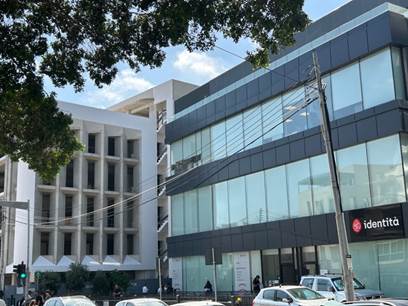
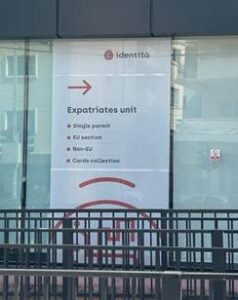
Images 1-2: Pictures of Identity Malta/Identità Malta, August 2025. Courtesy: Dr. Jaafar Alloul
Phase 3 of the STSM was spent deliberating the empirical insights gained in the interviews with Maltese colleagues at the UoM. Some emerging trends and preliminary insights can be alluded to in this blog. Prior to suggesting a first major trend, some additional context is required. There is a societal discourse in Malta about the increasingly excessive burden of migration—the Maltese expression “Invazawna!” is widespread—especially among young people, that is, young professionals starting their careers but unable to find affordable housing in a rental market that is overheated due to foreign investment, tourism, and market speculation. Rather than addressing some the complex issues partly undergirding the emergence of such xenophobia, the government of Malta seems to have prioritized further private property development rather than enlarging the market through mixed housing projects (with little structural re-investments in basic infrastructure, like the electricity grids). As one bureaucratic put it:
Paradoxically, it was the socialist party that initiated a large-scale immigration of TCNs, around 13 years ago. They wanted cheap labor, but to the long-term detriment of the Maltese. […] Now Malta has become more cosmopolitan and interesting to live in, but we might have gone overboard in terms of being able to carry this volume in immigrant population; we don’t need so many workers in certain sectors. It drives wages down and it heats up further the housing market and strains the public infrastructure. (Anonymous bureaucrat, Identity Malta)
These developments are today coupled with ever-more racism towards colored immigrants, especially of South Asian, African, or Muslim descent. That said, the first major trend in Malta is that a set of ‘second generations’ is now coming of age; many global migrants, the so-called Third Country Nationals (TCNs), have families and children in Malta, many of whom were born in Malta and speak Maltese. While Malta added ius sanguinis to its ius soli criterion in 1989 (doing away explicitlywith it the former provision in its Constitution in the year 2000), and while relevant legislation now allows people to apply for citizenship after 5 years of residency (under continuous working permits), the implicit understanding is that it takes at least 10 years for applications (including mandatory integration courses) to have a substantially higher success rate. Given that the arrival of TCNs only gained traction in volume around 11 years ago, the process of naturalization of TCNs is only starting to materialize now (2024-2025 onward), as per confirmation by officials of Identity Malta, the government branch responsible for such applications. This upcoming trend will engender new sociological dynamics in Malta, becoming a more formalized ‘multi-ethnic’ state, for instance, with large diasporas of a great number of countries among its citizenry, as per claims of state officials:
No government will fully be able to change the fact that Malta will hold a more multi-ethnic citizenry in the future. (Anonymous bureaucrat, Identity Malta)
That is, if they are effectively granted citizenship. While TCNs seem to incrementally receive citizenship, based on anecdotal evidence among such communities, developments in this realm are not solely based automatic due process as per bureaucratic turnaround. There is a great deal of discretionary policy work at play in the national administration, it seems, and many Maltese voice skepticisms as to whether a large-scale naturalization will in fact materialize in the coming decades. There is especially a lot of political discretionary power in the ministerial sign off for any naturalization process, now bestowed in the power of the Minister for Home Affairs, Security and Employment. One example of indicative thereof is found, for instance, in the naturalization-by-merit clause of the Maltese Citizenship Act:
The Minister may, in his discretion, grant a certificate of naturalisation as a citizen of Malta to any alien or stateless person who makes application therefor in the prescribed manner and satisfies the Minister that he is of full age and capacity and is of good character: Provided that the Minister may also grant a certificate of naturalisation to any person who has rendered exceptional services to the Republic of Malta or whose naturalisation is otherwise of exceptional interest to the Republic of Malta. (Article 10(9), Maltese Citizenship Act (Cap. 188))
Yet several bureaucrats with insight into the system do see it as a pending fait accompli that many TCNs will naturalize over time—a socio-demographic trend no single government will be able to easily turn around—if alone due to their substantial share in the demography and the importance they play in the (service and tourism) economy. Given that the 5-year rule to naturalize implies, in practice, at least 10-years, it is not inconceivable indeed that residents will be made to wait even longer; a practice common in other restrictive (and punitive) migration regimes (Lori 2021). Still, and what is important for research matters, whatever direction is taken, it is clearly a defining moment for Malta’s contemporary citizenship regime, and further inquiry in the near to medium future will be able to determine the actual course thereof, especially when more statistical data is produced and made publicly available. A caveat here, and an open question in relation to TCNs in Malta, is whether naturalized TCNs will in fact stay in Malta once granted citizenship, or move onwards inside the Schengen zone, as is oft speculated by the Maltese.
This brings us to the second interesting trend. Hitherto, most naturalizations in Malta have actually occurred under the legal pathway of the controversial ‘Citizenship-by-Investment Program’—the so-called “golden passport” scheme (Surak 2023)—the name of which was recently changed to the ‘Malta Citizenship by Naturalization for Exceptional Services’ scheme, following a European Court of Justice (ECJ) ruling in April 2025, stating the former program to be illegal. The fact that most naturalization in Malta happened under this questionable investment scheme is indicative of the classed nature of the Maltese migration and citizenship regime, especially given the highly discretionary nature of these naturalizations (on an ad hoc basis by senior bureaucrats) and the fact that these ‘migrants’ are exempted from any of the mandatory integration courses. This is even more striking when contrasting these privileged migrants-turned-citizens to asylum seekers and refugees in Malta. An interview was conducted, for instance, with an African-descent resident in Malta who received international refugee protection and recently applied for citizenship after completing all the formal requirements to do so. She was thereafter denied without any motivated explanation, echoing—as a third inferred trend in this overview—some of the Maltese bureaucrats’ statements about the arbitrary and ad hoc nature of Maltese citizenship allocation processes, as well as latent forms of racism potentially co-influencing perceptions (and decisions) in the national bureaucracy about colored ‘Africans’ in Malta.
Differently positioned residents in Malta seem to be made to ‘wait’ different intervals in attempts at citizenship acquisition, depending not on their formal compliance with legal (e.g. duration and integration) criteria but rather to do with a variety of sociological status makers (gender, class, race, age, bodily ability, specific legal status in residence etc.). Some of the interviewed bureaucrats spoke of incompetence by the senior bureaucratic class in bringing about such arbitrary treatment:
They run the show but often have no legal background and try to delay some people’s application as much as possible for reasons that are sometimes illegal. This is not smart because they will likely appeal and return in the candidate files, which means double the work and less efficiency in our work. When we address this, even suggesting that there are other legal venues to address migration limitations in state affairs, it’s clear that they don’t care about that. It is a ridiculous paradox, but it is political. (Anonymous bureaucrat, Identity Malta)
Poignantly, one of the Maltese bureaucrats interviewed (holding a legal background) himself spoke of a legal saying applicable to such bureaucratic practices of seemingly deliberate delay: “When justice is delayed, justice is denied”. Rather than a cynical framing, this nerve-wrecking treatment may be the everyday reality for many less privileged residents in Malta. In fact, the latter appear themselves aware of such state practices, which they try to navigate to the best of their abilities; mustering the little energy they have left, with their limited resources, and with support often of their social networks among local Maltese citizens (in solidarity with their plights) to fend off such realities in what seems to be a test of long-term endurance in the face of bureaucratic discrimination. We need to bear in mind that this state maneuvering is at play while Malta is marketing itself as an ideal hub for ‘digital nomads’, predominantly made up of (White) middle-class (tertiary-educated) tech professionals, suggesting yet another (classed) mechanism of deliberate “categorical tiering” (Jamal 2015) of the immigrant-resident population.
Malta’s migration regime is clearly hierarchically discriminatory, and its citizenship regime is exclusive, if not in full transformation. Interestingly, and as shown by the recent (and aforementioned) ECJ-ruling on the Maltese ‘selling of passports’, the island nation is still bound by European law and is thus constantly adapting its approach, if only in name, experimenting with new models in citizenship allocation and then adapting nominal elements thereof when scrutiny is cast upon it. This European umbrella, by the way, is not only perceived as a nuisance by consecutive Maltese governments (from across the political spectrum) but equally by elements of the state bureaucracy, who disclose during interviews how the Maltese specificity in terms of migration and citizenship regime is in fact much more global in its overall modelling, than a surface-level (and paternalistic) analysis would suggest—with many dismissing it as ‘peripheral’ legal anomalies of rogue state elements engaged in neo-feudal and crony-capitalist corruption. Yet, as emphasized by Maltese bureaucrats themselves, and much like other ex-British colonial dominions rising on the global stage: “Without the EU, the migration system here would be exactly like Dubai: you come, you work, and you leave.” Maltese citizenship is no longer perceived as being a broad and inclusive right (to all those born there) but rather a privilege granted (in oft discretionary ways) to specific categories of residents only. These inferences about the Maltese migration and citizenship regimes are preliminary in nature, require further analysis, as well as diligent follow-up research. They will serve as a precursor in drafting a special issue proposal that will be submitted to a relevant academic journal, which will be focused on sociologically comparing citizenship trends around the world which are now becoming more dominant and normative.
