Dates: 25–26 March 2026
Venue: Philological Faculty, University “Ss. Cyril and Methodius” (UKIM), Skopje
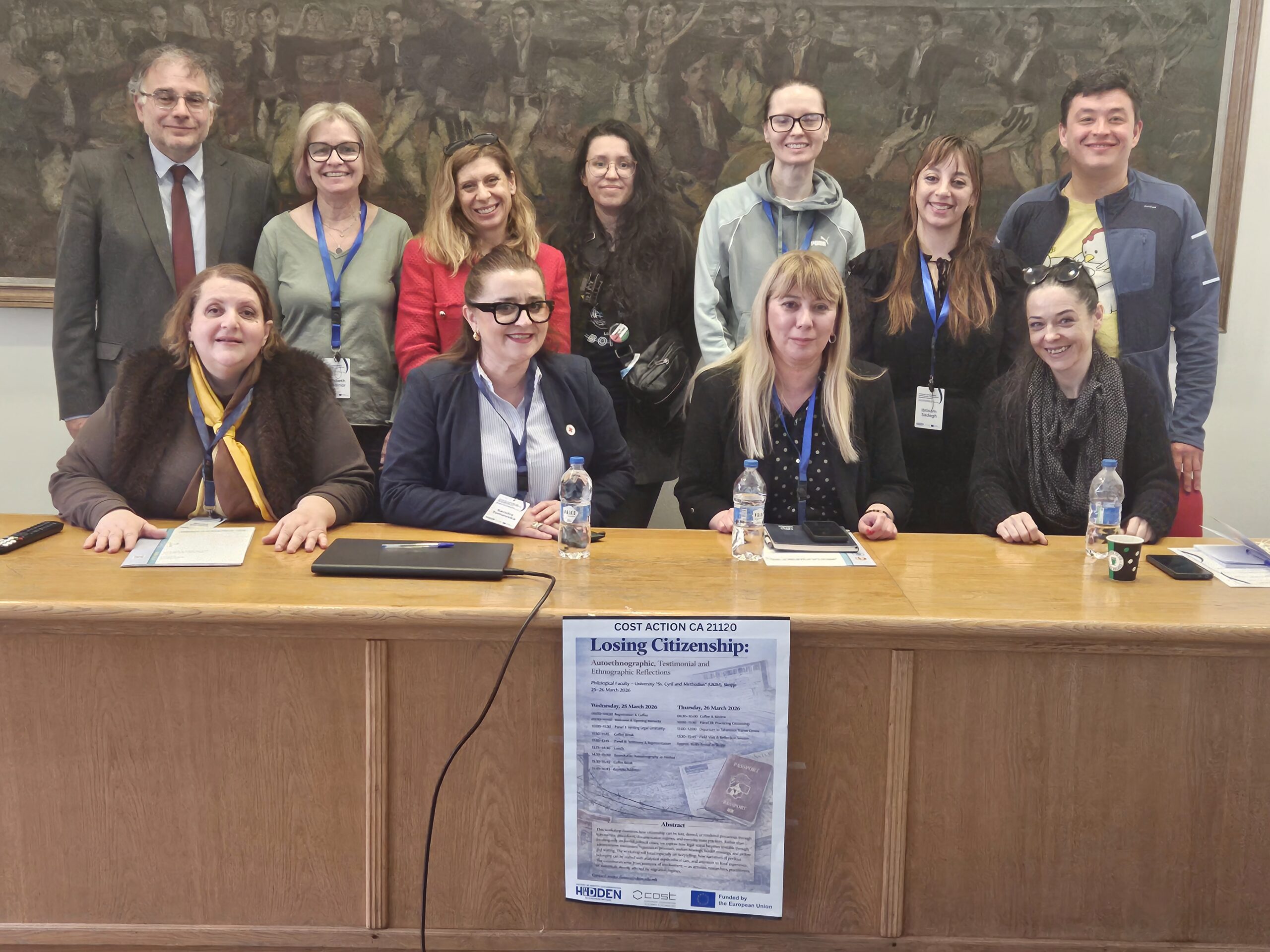
Losing Citizenship: Autoethnographic, Testimonial and Ethnographic Reflections, organized by Working Group 4, convened anthropologists, legal scholars, writers, and humanitarian practitioners to examine citizenship loss not as an abstract policy issue, but as a lived, narrated, and survived experience.
A Workshop Built on Three Registers
The program’s structure demonstrated its intellectual ambition from the outset. Rozita Dimova, Ibtisam Sadegh, and Evgeny Shtorn welcomed participants on March 25, outlining a workshop designed to move systematically among three registers: the autoethnographic (scholars analyzing their own experiences of identity and belonging), the testimonial (first-person accounts of statelessness and displacement), and the ethnographic (fieldwork-based studies of how states, courts, and aid organizations address individuals with contested citizenship).
Day One: Law, Testimony, and the Colonial Gaze
The first panel, moderated by Natalija Shikova, examined how legal liminality is constructed in courtrooms, case files, and surrounding narratives. Elizabeth Challinor, Assistant Researcher at the Centre for Research in Anthropology at Nova University of Lisbon, contributed insights from two decades of work on migration, citizenship, and belonging in her presentation, “Mastering Laws and Bureaucracy: How Knowledge and Acts of Care Combine to Create Citizenship.” Her methodology, which integrates reflexive, narrative-driven research with creative forms such as poetry and theatre, exemplifies the workshop’s broader theme: ethnography itself can constitute a form of care.
David Zammit, a Maltese anthropologist and legal scholar, provided a personal perspective in his presentation, “Defining Maltese Identity under the British Gaze.” Born in England and renouncing his English citizenship at eighteen to study in Malta, Zammit addressed the intersection of law and anthropology, as well as the linguistic and national hybridity that characterize Maltese identity and are influenced by Arabic, Italian, and English traditions. Isabel Arce Zelada, a social anthropologist at University College Dublin with personal experience of statelessness, concluded the panel with “Testimonies from an Alien,” drawing upon doctoral research into narrative inequality within the UK asylum system and the Who We Are art collective, which she founded to showcase artwork by individuals navigating that system.
The second panel focused on the ethics of representation. Moderated by Dr. Ibtisam Sadegh, the panel included Dr. Olga Kenton, a writer and Fellow of Advanced HE, whose presentation, “Going Beyond Boundaries: Ethics and Emotions of Immigrant Testimonial Writing,” drew on her research on Russian émigré literature and translingual creative writing. Evgeny Shtorn, a PhD candidate at the University of Helsinki researching violence against LGBTIQ+ individuals in Russia, contributed insights from over two decades of human rights advocacy, addressing issues of protection, mobility, and relocation.
The afternoon session adopted a reflective tone, featuring a roundtable discussion with all four morning speakers on autoethnography as both a methodological approach and an intervention. Dr. Andrew Herrmann, Co-Editor-in-Chief of the Journal of Autoethnography, then delivered a keynote address, concluding a day that moved from courtroom narratives to embodied testimony and disciplinary reflection.
Day Two: From the Seminar Room to the Border
While the first day focused on narrating loss, the second day addressed the institutional mechanisms underlying citizenship loss. Panel III, moderated by Rozita Dimova, featured practitioners working at the margins of citizenship: Jasmina Golubovska, Program Manager at the Skopje-based organization Legis, who has specialized in humanitarian law and migration since 2015 and holds a master’s degree from the joint Bologna–Sarajevo program in Democracy and Human Rights; a representative from the Red Cross of the Republic of North Macedonia, whose field experience includes the 2015 migrant crisis response in Lesbos; and Aleksandra Efremova of the Macedonian Young Lawyers Association, whose extensive statelessness casework includes assisting over 800 formerly stateless individuals in obtaining Macedonian citizenship and contributing directly to national legislation on civil registration, residence, and identification documentation, including co-authoring legal amendments at the request of the Ministry of Justice.
A final roundtable, “Narrating Loss — From Autoethnography to Institutional Practice,” synthesized the workshop’s two days by examining how scholarly and testimonial insights inform institutional practice.
The day concluded with an uncommon feature for an academic workshop: a field visit. After a practical briefing on logistics and research ethics, participants visited one Transit Center, a site directly relevant to the workshop’s central themes.
Why the Format Matters
A distinguishing feature of this workshop is its integration of scholarly, personal, and practical perspectives. The program included a researcher who renounced his citizenship at eighteen, a lawyer who has resolved 800 statelessness cases, a collective of asylum-seeker artists, and the editor of an academic journal on self-narrative research. The workshop concluded not in a seminar room, but at a transit centre, where theoretical discussions intersected with the lived experiences of affected individuals.
