
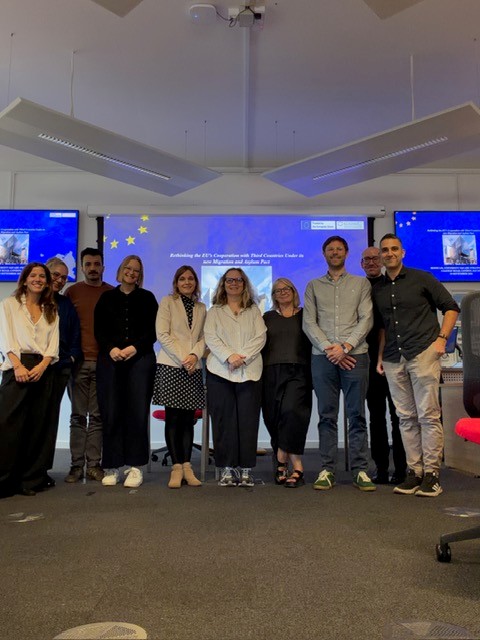
On Thursday, 10 September 2026, the Royal Docks School of Business and Law at the University of East London hosted a crucial workshop titled Rethinking the EU’s Cooperation with Third Countries Under its new Migration and Asylum Pact. Funded by the European Union through the COST Association Action CA21120—History of Identity Documentation in European Nations: Citizenship, Nationality and Migration—this event brought together leading legal scholars, and political scientists to dissect the external dimensions of the latest turns in EU Asylum and Migration policy. Organized by Working Group 3 members – Dr Romit Bhandari, Professor Michael J. Geary, Dr Annalisa Meloni, and Dr Susan Beth Rottmann – the workshop served as a critical forum for unpacking the geopolitical, ethical, and legal ramifications of the EU’s externalized migration control.
The Rise of ‘Return Hubs’ and Externalized Control
The morning sessions quickly delved into the mechanical realities of the new Migration and Asylum Pact. Elsa Fernando Gonzalo (University of Salamanca) opened the day by tracing the shift from informal agreements to extraterritoriality, framing “Return Hubs” as the latest iteration of what she termed the EU’s “Returnmania”. This evolving architecture was probed further by Levent Pişkin (University of Dundee), who exposed the widening “accountability gaps” caused by the deliberate de-formalisation of EU cooperation with external nations. A core concern running through the day was the erosion of fundamental rights safeguards under the guise of state neutrality. Neva Öztürk (Ankara University) challenged the notion of ‘voluntary’ returns, analysing how ‘constructive refoulement’ operates behind a veil of voluntary rhetoric to shift responsibilities away from member states.
Geopolitics, Finance, and Migration Diplomacy
The afternoon panel highlighted the complex interplay between law, money, and state sovereignty. Romit Bhandari and Annalisa Meloni co-presented a vital paper examining how the concept of “instrumentalisation” has been constitutionalised within EU law, questioning whose emergency is truly being prioritised. Money, power, and leverage took centre stage in the presentation by N. Ela Gokalp-Aras (Swedish Research Institute in Istanbul). Joining online, she mapped out the ‘financialised externalisation’ under the new Pact, evaluating how funding mechanisms reshape power dynamics and influence third-country agency, specifically within EU-Türkiye migration governance. Adding to this, Saila Heinikoski (Finnish Institute of International Affairs) detailed how externalization and conditionality have become formalised tools of modern ‘migration diplomacy’.
Shifting Identities and Legitimate Partnerships
The final presentations looked closely at institutional strategies and identity politics. Paula Hoffmeyer-Zlotnik (Sciences Po Paris) and Frowin Rausis (University of Geneva) explored the institutional ‘face-work’ required to align aggressive externalization tactics with the idealized ‘European Way of Life’. Closing the paper presentations, Johan Ekstedt (Université Libre de Bruxelles) examined how the European Union Agency for Asylum (EUAA) models ‘legitimate partners’ to validate externalised control mechanisms.
Looking Ahead
The workshop concluded with a wrap-up session mapping out future research directions, including follow up plans to publish the workshop papers in the special issue of a journal. As the EU continues to implement its new Migration and Asylum Pact, the insights shared at UEL demonstrate that externalisation is not just moving borders outward—it is fundamentally rewriting the rules of international accountability, legal responsibility, and human rights.
