HIDDEN COST Action Workshop: Reflecting on Gender In/Equality in the Academy
Blog post by Dr Jennifer Redmond
On 4-5 september 2025 members of the HIDDEN COST Action were hosted by the Centre Universitaire de Norvège à Paris (CUNP) at the Fondation Maison des Sciences de l’Homme in Paris to reflect on issues of gender and gender inequalities in the university sector. The purpose of the workshop was two-fold – to support early career scholars in our network to advance a work in progress chosen by them, and to collate knowledge and gain feedback to inform our own Gender Equality Plan.
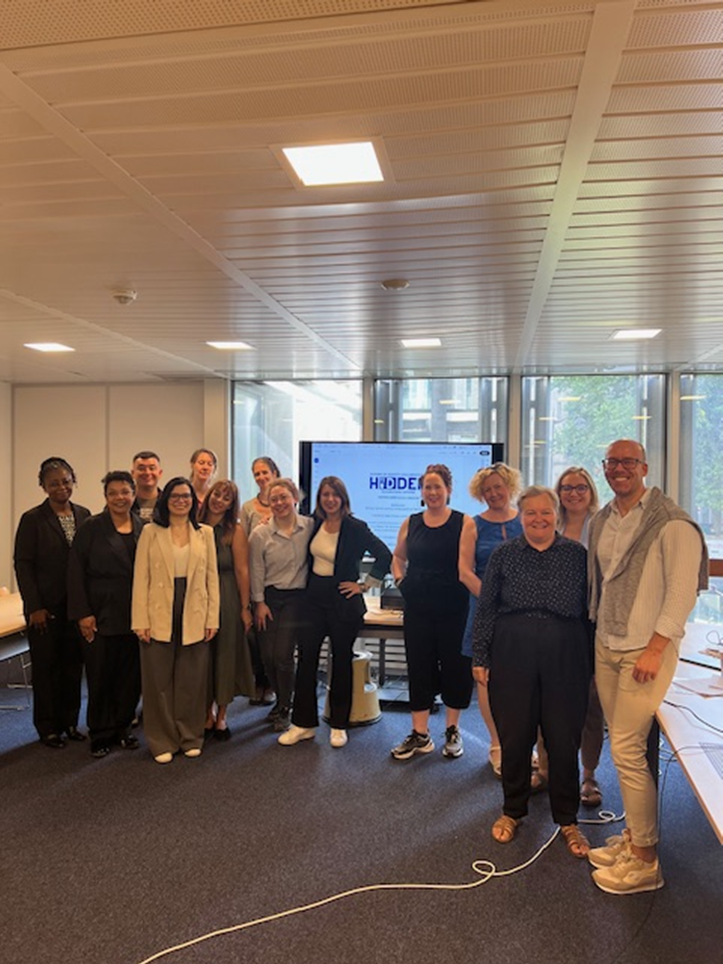
(Photo credit: Michael J. Geary)
This workshop was developed after reflecting on the purpose of the Action and to uphold the principles of equality and inclusion that are the bedrock of COST initiatives. The landscape of academia has long been shaped by structural, cultural, and institutional factors that influence gender equality and inequality. Despite progress, disparities in representation, pay equity, career advancement, and leadership opportunities persist, impacting the academic experiences of individuals across disciplines. This workshop invited early career scholars to critically engage with these issues, examining both the barriers and pathways to achieving a more inclusive academic environment, not least through different funding scheme at the national and European levels.
On Day 1, participants were welcomed by Dr Jennifer Redmond (Maynooth University), Chair of HIDDEN, and Prof. Michael J. Geary (NTNU Norway), HIDDEN Gender Equality Coordinator who also arranged the location thanks to the support of his university. Participants were all early career scholars currently working on journal articles, book proposals, and/or funding applications who circulated drafts in advance of the event.
The first keynote was chaired by Dr Jennifer Redmond and was given by Prof. Anne-Sophie Godfroy (École Normale Supérieure), Chair of the recently concluded COST Action VOICES: “Making Young Researchers’ Voices Heard for Gender Equality”who spoke on ‘How and why should we design and implement GEPs in COST Actions (and in research projects in general)?’. Professor Godfroy reflected on her role as Chair of this Action and the research they conducted that reflected on gender equality in all disciplines. After a break, the next keynote was chaired by Professor Michael Geary and was given by Prof. Valerie Heffernan (Maynooth University) on gender equality aspects to EU Funding Schemes. Prof Heffernan is an experienced evaluator and was instrumental in the Mothernet project, a networking project that engaged researchers in humanities, social sciences and medicine from three Universities: Vilnius University, Lithuania, Maynooth University, Ireland and Uppsala University, Sweden.
After this, the group participated in a discussion and a gathering of best practices at national, European, and International funding schemes that encompassed gender equality issues, including maternity, paternity and parental schemes, mentoring, specific access to research supports or funding for caring responsibilities, including direct childcare costs or funding of travel for dependents. These set of policies, while not globally comprehensive, chart a set of procedures which acknowledge issues of gender in/equality and offer best practice solutions. The information gathered as a result of this workshop will help to shape how HIDDEN continues to operate, being mindful of gender equality in positions of leadership, the allocation of grants, places at event and will also feature in the new HIDDEN Gender Equality Plan.
In the final session of the day, early career researchers gave the first round of presentations on their works in progress. Chaired by Prof Michael Geary. Dr Zoe O’Reilly (Maynooth University) and April Maja Almaas (NTNU Norway) presented on proposals to fund workshops on key areas related to their research. Dr Pilar Luz Rodrigues (University of Galway), Evgeny Shtorn (University of Helsinki) both presented on articles they are working on related to their present research. Finally, Dr Aisling Shalvey (University College Cork) presented on a book proposal.
Day 2 began with the third and final keynote, chaired by WG5 co-leader Dr Beatrice Scutaru (Universitat Autònoma de Barcelona). Dr Concetta Russo (Università degli Studi Guglielmo Marconi) gave a presentation on ‘Between Constraint and Discovery: Motherhood, Identity and Academic Becoming’ which drew upon her research on academia and motherhood, which can be read in her article ‘Becoming a mother in neoliberal academia: Subjectivation and self‐identity among early career researchers’ from the journal Gender, Work and Organisation (part of a special issue edited by members of Mothernet, Anne O’Brien, Eglė Kačkutė, Marian Crowley-Henry).
In the final session of the workshop, Vice Chair Dr Aisling Shalvey chaired the session which had presentations from Dr Beatrice Scutaru (Universitat Autònoma de Barcelona), Dr Lucy Pius Kyauke (NTNU Norway) Dr Ibtisam Sadegh (University of Malta) and Dr Andrea Berger (University College Dublin) all presented on an article they are presentlt working on and received feedback from the group. The event closed with the group making final amendments to the HIDDEN Gender Equality Policy Statement which will be finalised in the coming months.
The organisers requested anonymous feedback from the group about their experiences of the workshop. These responses are useful in identifying the benefit of the workshop, which could be rolled out again to other early career scholars in and beyond the network, and the following response is a fitting note to end on: ‘The event was a special and small gathering of researchers. It was warm and welcoming and the small number of people attending meant that many quality conversations could be had. The guest speakers were really interesting. The most important aspect of the event for me – apart from networking and conversations – was the awareness of the challenges of being a woman and parent working in academia and the fact that these challenges are systemic, and thus shared’.
The organisers would like to offer un grand merci/tusen takk to Center Director Dr Marte Mangset and her administrative colleague, M. Yann Hascoët, for their wonderful hostpitality over the two days.
