On 27-29 November 2025, WG2 organised a workshop on Material Traces of Documentation and Migrants’ Agency, hosted at the Documentation Center and Museum of Migration in Germany, in Cologne, and funded by HIDDEN COST. In this workshop, national histories were comparatively interrogated with a transnational approach to historical issuing of ID from multidisciplinary and interdisciplinary perspectives. The participants, Dr Nađa Beglerović, Ms Andrea Berger, Dr Natalie Brinham, Dr Lucrezia Canzutti, Dr Cristina Diac, Dr Brigitte Le Normand, Dr Francesca Piana, Dr Jennifer Redmond and Dr Tatjana Šarić were all tasked with presenting a case to the group and discussing the broader themes that occur in relation to the DOMiD collections. The perspective of the DOMiD collection is particularly unique, as it includes material collected by migrants that reflect their journey and story, rather than exclusively administrative records. This adheres to our broad aim in HIDDEN COST to ensure ‘nothing about us without us’ in relation to migrant stories and identity documentation.
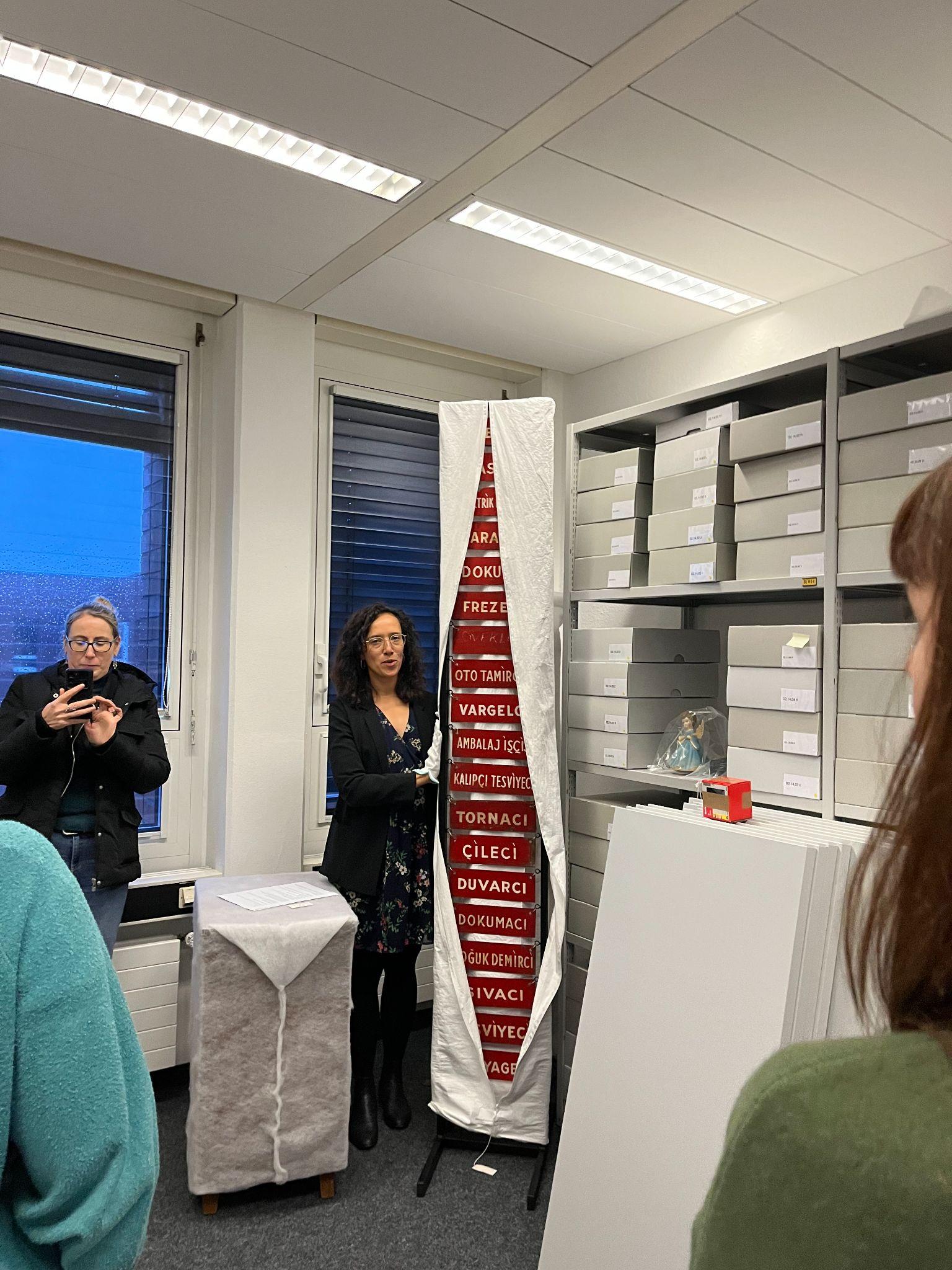
Our day began with a welcome address from Jennifer Redmond, describing the aims of HIDDEN COST, who states that it is not only important archivally what stories are told, but also who gets to tell that story. This led into our tour of the DOMiD collections, where Bebero Lehmann guided us through some of the physical objects they have on loan. This distinction is important that it is on loan, as objects are not given as a donation. The ownership of the collections is with the original maker, and so they have a choice in how it is used and exhibited, and they are always consulted. Individuals can take the object back whenever they choose, almost like a lending library. This was particularly interesting when looking at some of the signs used in protests over the years, which can be checked out by migrant community groups to be used again, while they continue to loan more material to the collection.
Individual presentations followed, where: Dr Andrea Berger reflected on state documentation of refugees in Germany after Schengen. She looked at the changing nature of state documentation of identity, and the lack of perspective and experience of documentation practices by refugees themselves.
Dr Aisling Shalvey presented a case study of documents from the Arolsen Archive. She reflected on how children often had their identity and nationality chosen for them by their parents in the postwar era in Germany, but this could have lasting consequences in terms of their acceptance or rejection both societally and administratively.
Dr Natalie Brinham discussed how those in Rohingya refugee camps go about proving their past and their identity through self-archiving, even when retention of documentation is seen as a form of rebellion; having documentation to prove a group has always been there is a radical move.
Dr Lucrezia Canzutti examined the ‘document purge’ against Vietnamese between 2017-2018 in Cambodia. She reflected on how this bureaucratised and racialised violence produces statelessness through a series of spatio-temporal erasures.
Dr Cristina Diac discussed surveillance and the Yugoslav state retaining passports, and asked the question if civilians felt this experience as surveillance, and if they saw the data collector as trustworthy.
Dr Brigitte Le Normand reflected on women migrants from the Northern Mediterranean region, and their work in postwar northwestern Europe. She noted that women are subject to different kinds of regulations, their experiences do not necessarily replicate the experiences of men.
Dr Francesca Piana examined the Nansen identity documentation as passport, and how statelessness centres a legal perspective, when there are other methodologies to frame identity documentation.
Dr Tatjana Šarić provided an overview of archival resources and challenges related to researching identity documents and tracing migrants’ lives in the Croatian State Archives (CSA). She outlined how, despite the organisational problems, it is an essential resource for reconstructing historical migration patterns and identity documentation.
The event ended with a roundtable where we discussed the broader questions raised in the workshop: Who makes the documents and for what purpose are they made? When do they get used and how? How does the material end up in the archive and what purpose does it serve at different moments in time? We reflected on the individual and collective uses of documentation to create identity, especially for migrant communities, along with the symbolic role of documentation versus evidentiary role of documentation today. Ambiguities in historical record, and the need to think critically about the data that exists, as well as the data that does not exist was raised as an ongoing question of our group.
